

Understanding angles is fundamental in geometry and plays a crucial role in various real-life applications, from architecture to engineering. Whether you are a student seeking to master the topic or simply a curious learner, engaging in angle exercises can significantly enhance your comprehension and retention of the concepts. In this article, we will delve into different types of angles, present various exercises, and provide the solutions so you can assess your understanding.
Ready to challenge yourself? Let’s explore the world of angles, starting from the basic definitions to more complex exercises that will test your skills!
Understanding the Basics of Angles
Before diving into exercises, it’s essential to grasp what angles are and how they are classified. An angle is formed when two rays, known as the sides of the angle, meet at a common endpoint called the vertex. Angles are measured in degrees (°) and can be categorized into several types:
- Acute Angle: Measures less than 90°.
- Right Angle: Measures exactly 90°.
- Obtuse Angle: Measures more than 90° but less than 180°.
- Straight Angle: Measures exactly 180°.
- Reflex Angle: Measures more than 180° but less than 360°.
These classifications are fundamental for solving various mathematical problems involving angles. Understanding these concepts will prepare you for the exercises to follow.
Exercises on Angles for Primary Students
Now that you are familiar with the types of angles, let’s put your knowledge to the test with some exercises designed for primary school students. These exercises will help reinforce the concepts we've just covered.
Exercise Set 1: Identifying Angles
In this section, you will observe various images of angles. Your task is to identify the type of angle represented in each image. Here are some examples:
Esto también te interesa...Understanding Frequency Concept in Statistics- Determine the type of angle for the following images:
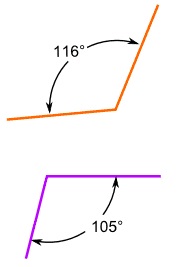 |
Angle A: What type of angle is it? |
 |
Angle B: What type of angle is it? |
 |
Angle C: What type of angle is it? |
Exercise Set 2: Measuring Angles
Now, let’s move on to measuring angles. For the following angles, use a protractor to determine their measurements. Record your answers:
- Angle D: What is the measure of this angle?
- Angle E: What is the measure of this angle?
- Angle F: What is the measure of this angle?
Exercises on Complementary and Supplementary Angles
Complementary angles are two angles that add up to 90°, while supplementary angles are two angles that sum to 180°. Understanding these concepts is critical as they frequently appear in geometry problems.
Let’s try some exercises related to these types of angles:
Exercise Set 3: Finding Complementary Angles
For the following angles, find the complementary angle:
- If Angle G is 30°, what is its complement?
- If Angle H is 75°, what is its complement?
- If Angle I is 45°, what is its complement?
Exercise Set 4: Finding Supplementary Angles
Now, let’s find the supplementary angles:
- If Angle J is 120°, what is its supplement?
- If Angle K is 90°, what is its supplement?
- If Angle L is 150°, what is its supplement?
Exploring Notable Angles: 30°, 45°, and 60°
Angles of 30°, 45°, and 60° are significant in various mathematical contexts, particularly in trigonometry. They are often used in problems involving triangles and circles. Familiarizing yourself with their properties can simplify many calculations.
Esto también te interesa...Understanding Frequency Concept in StatisticsExercise Set 5: Identifying Notable Angles in Triangles
For the following triangles, determine the measures of the unknown angles:
- Triangle M has angles of 30° and 60°; what is the measure of the third angle?
- Triangle N has angles of 45° and 45°; what is the measure of the third angle?
- Triangle O has angles of 30° and 30°; what is the measure of the third angle?
Advanced Angle Exercises for Secondary Students
As students progress, they encounter more complex problems involving angles. Here are some advanced exercises that challenge your understanding:
Exercise Set 6: Angles in Parallel Lines
When a transversal crosses parallel lines, it creates several pairs of angles. Your task is to find the measures of the unknown angles.
- Angle P is alternate interior to Angle Q, which measures 70°. What is the measure of Angle P?
- Angle R is corresponding to Angle S, which measures 110°. What is the measure of Angle R?
- Angle T is same-side interior with Angle U, which measures 60°. What is the measure of Angle T?
Exercise Set 7: Solving for Unknown Angles
In the following scenarios, find the unknown angle using given angle relationships:
- If Angle V is 80° and is vertical to Angle W, what is the measure of Angle W?
- If Angle X is 120° and is adjacent to Angle Y, what is the measure of Angle Y?
- If Angle Z is 90° and is complemented by Angle A, what is the measure of Angle A?
Solutions to the Angle Exercises
It’s time to check your answers! Below are the solutions to the exercises presented earlier:
Solutions for Exercise Set 1: Identifying Angles
- Angle A: Obtuse Angle
- Angle B: Right Angle
- Angle C: Acute Angle
Solutions for Exercise Set 2: Measuring Angles
Answers will depend on the actual angles measured using a protractor. Expected results will vary based on the angles depicted.
Esto también te interesa...Understanding Frequency Concept in StatisticsSolutions for Exercise Set 3: Finding Complementary Angles
- Angle G: 60°
- Angle H: 15°
- Angle I: 45°
Solutions for Exercise Set 4: Finding Supplementary Angles
- Angle J: 60°
- Angle K: 90°
- Angle L: 30°
Solutions for Exercise Set 5: Identifying Notable Angles in Triangles
- Triangle M: 90°
- Triangle N: 90°
- Triangle O: 120°
Solutions for Exercise Set 6: Angles in Parallel Lines
- Angle P: 70°
- Angle R: 110°
- Angle T: 120°
Solutions for Exercise Set 7: Solving for Unknown Angles
- Angle W: 80°
- Angle Y: 60°
- Angle A: 90°
By working through these exercises, you’ve taken significant steps in mastering the concept of angles. Remember, practice is essential in mathematics, and the more you engage with these problems, the more proficient you will become at solving them.
Continue to explore angles in various contexts, as they are a fundamental part of geometry. Keep practicing, and soon you will tackle even more complex mathematical challenges with confidence!

He colaborado con universidades privadas en Latinoamérica, liderando iniciativas de captación, retención, empleabilidad y transformación digital. Como escritor, traduzco estrategias educativas en mensajes claros, persuasivos y accionables.
Combino experiencia académica, pensamiento estratégico y enfoque en resultados. Aquí comparto ideas para instituciones que quieren adaptarse al futuro… antes de que el futuro las arrase.
📬 ¿Quieres transformar tu institución o afinar tu mensaje educativo?
Hablemos.
- Domain and range of an algebraic function - octubre 28, 2026
- How to Calculate Percentages Effectively - octubre 28, 2026
- Understanding the concept of algebraic function - octubre 28, 2026
Si quieres conocer otros artículos parecidos a Angle Exercises for Improved Geometry Skills puedes visitar la categoría Math.
Deja una respuesta
Más artículos sobre este mismo tema